Aim 5
Welcome & Access

Aim 5
Welcome & Access
Aim 5:
Welcome & Access
A valued South Downs National Park is welcoming and accessible to all.

Tap for sound.
Click for sound.
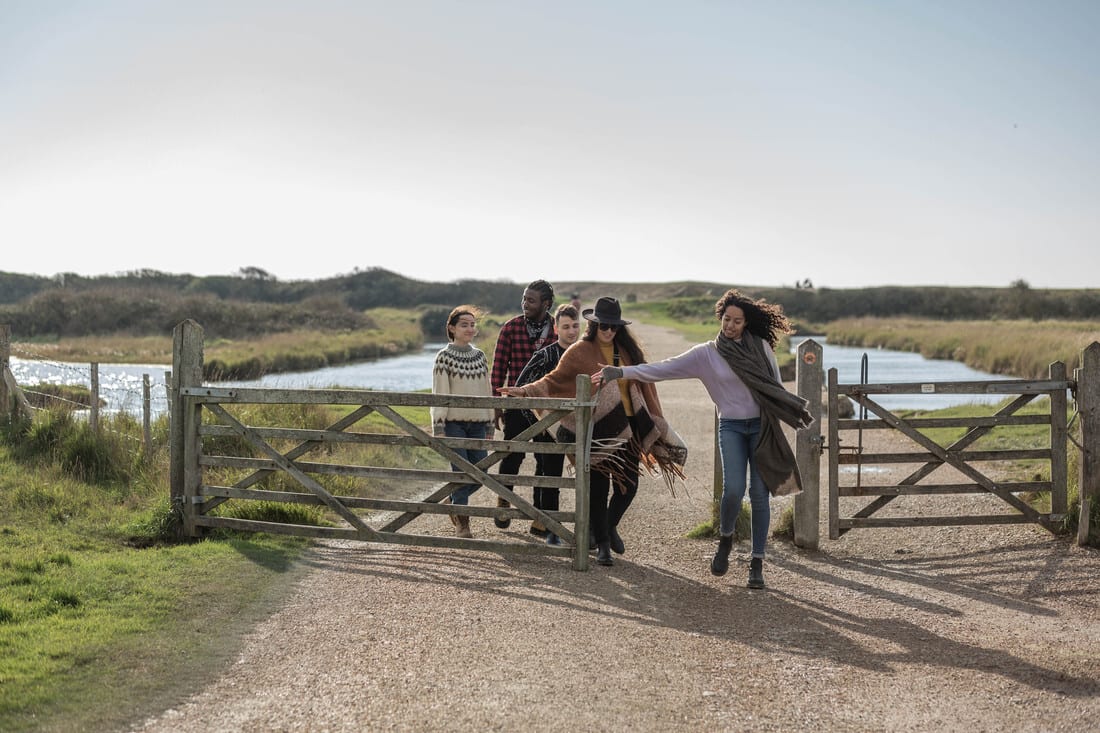
Every year the South Downs welcomes 19 million visitors. With over 3,300km of rights of way, two National Trails (the South Downs Way and the King Charles III England Coast Path), new trails connecting the urban fringe into the heart of the National Park, breathtaking landscapes, a wealth of heritage to be explored, lively market towns and picture-perfect villages, it is easy to understand why.
Over 113,000 people call the National Park home in its towns, villages and rural communities, and another 2 million people live within 10km. This National Park is therefore providing access to nature, green space, health and wellbeing opportunities, dark night skies, a living classroom for young people, and much more, to millions of people in the busiest part of the UK.
At the heart of access is connection and a feeling of belonging, being part of a wider and wonderfully diverse National Park community united in a common purpose to enjoy and care for your National Park.
Together we are committed to giving everybody the opportunity to get out and enjoy the National Park.
© SDNPA
Why is Welcome and Access so vital?
Access also has an important role to play in supporting the local economy and in helping us to reach net zero. A key focus for us to benefit people, nature and the planet, is to provide better access from the urban fringe, supporting people to access the National Park by public transport or active travel – walking, wheeling, cycling and horse riding. The National Park has a range of overnight accommodation for visitors. A range of different types of visitor accommodation is important to support different needs and budgets, making the National Park more accessible to more people.
Along with our Miles Without Stiles routes, we’ve really been able to increase our offering to people with mobility challenges and other needs thanks to a grant in 2023 from Defra which enabled us to purchase mobility scooters and accessible bicycles at various key sites.2 At Seven Sisters Country Park, the only part of the National Park the Authority owns and manages, we have put accessibility at the heart of our work, with an accessibility guide on the website, a Changing Places toilet, Miles without Stiles route, an audio trail, accessible bikes, scooters and kayaks. For those who can’t get to us, we are working with partners to bring the National Park to them, through virtual walks, podcasts and 3D filming.
However, we also know that barriers to access are not all physical. Cost, transport, a lack of confidence or knowledge, and a fear of the National Park not being welcoming are just some of the barriers stopping individuals and whole communities from accessing the National Park. Public transport – or a lack of public transport – continues to be a barrier for many people to visiting and enjoying the National Park. We are working with partners to change this but know that there is still much to be done and for us to learn to support a truly welcoming and accessible National Park.
How people want to access the National Park is also changing. While walking and cycling remain ever popular, people are now wanting to experience our landscapes in different ways. They want to spend time with family and friends, to take action on climate and biodiversity loss, to have a positive impact on their mental health, to be inspired by the landscape to create, art, music and writing, to experience dark, starry skies and, sometimes, to just be. An accessible National Park is also about understanding and providing for the various ways people want to experience the landscape. This means easy access to information and inspiration, it means knowing what's out there, how to get there, when to go and above all, feeling like the National Park is for you.
Read more
Access also has an important role to play in supporting the local economy and in helping us to reach net zero. A key focus for us to benefit people, nature and the planet, is to provide better access from the urban fringe, supporting people to access the National Park by public transport or active travel – walking, wheeling, cycling and horse riding. The National Park has a range of overnight accommodation for visitors. A range of different types of visitor accommodation is important to support different needs and budgets, making the National Park more accessible to more people.
Along with our Miles Without Stiles routes, we’ve really been able to increase our offering to people with mobility challenges and other needs thanks to a grant in 2023 from Defra which enabled us to purchase mobility scooters and accessible bicycles at various key sites.2 At Seven Sisters Country Park, the only part of the National Park the Authority owns and manages, we have put accessibility at the heart of our work, with an accessibility guide on the website, a Changing Places toilet, Miles without Stiles route, an audio trail, accessible bikes, scooters and kayaks. For those who can’t get to us, we are working with partners to bring the National Park to them, through virtual walks, podcasts and 3D filming.
However, we also know that barriers to access are not all physical. Cost, transport, a lack of confidence or knowledge, and a fear of the National Park not being welcoming are just some of the barriers stopping individuals and whole communities from accessing the National Park. Public transport – or a lack of public transport – continues to be a barrier for many people to visiting and enjoying the National Park. We are working with partners to change this but know that there is still much to be done and for us to learn to support a truly welcoming and accessible National Park.
How people want to access the National Park is also changing. While walking and cycling remain ever popular, people are now wanting to experience our landscapes in different ways. They want to spend time with family and friends, to take action on climate and biodiversity loss, to have a positive impact on their mental health, to be inspired by the landscape to create, art, music and writing, to experience dark, starry skies and, sometimes, to just be. An accessible National Park is also about understanding and providing for the various ways people want to experience the landscape. This means easy access to information and inspiration, it means knowing what's out there, how to get there, when to go and above all, feeling like the National Park is for you.

Read More
Access also has an important role to play in supporting the local economy and in helping us to reach net zero. A key focus for us to benefit people, nature and the planet, is to provide better access from the urban fringe, supporting people to access the National Park by public transport or active travel – walking, wheeling, cycling and horse riding. The National Park has a range of overnight accommodation for visitors. A range of different types of visitor accommodation is important to support different needs and budgets, making the National Park more accessible to more people.
Along with our Miles Without Stiles routes, we’ve really been able to increase our offering to people with mobility challenges and other needs thanks to a grant in 2023 from Defra which enabled us to purchase mobility scooters and accessible bicycles at various key sites. At Seven Sisters Country Park, the only part of the National Park the Authority owns and manages, we have put accessibility at the heart of our work, with an accessibility guide on the website, a Changing Places toilet, Miles without Stiles route, an audio trail, accessible bikes, scooters and kayaks. For those who can’t get to us, we are working with partners to bring the National Park to them, through virtual walks, podcasts and 3D filming.
However, we also know that barriers to access are not all physical. Cost, transport, a lack of confidence or knowledge, and a fear of the National Park not being welcoming are just some of the barriers stopping individuals and whole communities from accessing the National Park. Public transport – or a lack of public transport – continues to be a barrier for many people to visiting and enjoying the National Park. We are working with partners to change this but know that there is still much to be done and for us to learn to support a truly welcoming and accessible National Park.
How people want to access the National Park is also changing. While walking and cycling remain ever popular, people are now wanting to experience our landscapes in different ways. They want to spend time with family and friends, to take action on climate and biodiversity loss, to have a positive impact on their mental health, to be inspired by the landscape to create, art, music and writing, to experience dark, starry skies and, sometimes, to just be. An accessible National Park is also about understanding and providing for the various ways people want to experience the landscape. This means easy access to information and inspiration, it means knowing what's out there, how to get there, when to go and above all, feeling like the National Park is for you.
Objective 5.1
To improve the accessibility of the National Park to enable everyone to actively travel and connect with nature and cultural heritage.
“Accessible” means different things to different people. For some, it is about being able to physically access a space. For others, it can be an ability to access transport or feeling welcome and safe.
We are also aware that not every part of the National Park can be accessible to all. The shared goal is partnership working to increase the opportunities for everyone to access the National Park.
Targets for Objective 5.1
Target 5.1a: PLTOF Target 9: By 2031, 300km (10%) of the National Park’s public Rights of Way network is in good condition and 'accessible'*.
Target 5.1b: By 2031 pilot 5 digital accessibility mapping surveys to provide network wide accessibility information.
Target 5.1c: Increase Active Travel to and within the National Park year on year through the delivery of Active Travel network improvements and infrastructure.
Target 5.1d: By 2031, improve sustainable access across the South Downs National Park by expanding public transport services to key visitor hubs and gateway towns.
* We will measure “accessible” in relation to our access network as routes which meet the “By all Reasonable Means” designation of “Paths for Some” or above. These routes must have no steps, stiles or barriers restricting access, have no gradient steeper than 1:10 and have a width of over 1m.
Read more about Objective 5.1
Enabling people to access the National Park starts well before they leave home. It is ensuring they feel welcome and then providing the information they need to plan their visit – whether that be a quick walk from a neighbouring area or travelling from further afield. Everyone should be able to access information relevant to their needs about how they can connect with the South Downs.
We are committed to bringing the National Park to people where they are – through online and digital content to inform and inspire. We are working with partners to provide onsite information. We are also broadening our partnerships to gather and share new voices and experiences of the National Park.
Our rights of way network – the largest in any National Park and including the entire 100-mile South Downs Way National Trail – is a jewel in the crown of the South Downs. However, it can be greatly improved through relatively small interventions, including removing obstacles such as stiles or steps where possible, improving the surfaces and just maintaining vegetation to increase accessibility and support nature. Improving difficult crossings of roads or developing new off-road routes where missing links exist will greatly enhance the usability of our existing network.
A little over 4 per cent of the National Park land area is Access Land (under the Countryside and Rights of Way Act 2000). Unlike many of England’s upland National Parks which have large continuous areas of Access Land, that in the South Downs is generally small, fragmented areas of downland or heathland. During the lifetime of this Partnership Management Plan, the National Park Authority will work with Natural England to review the current Access Land Open Country mapping, with a view to making this valuable asset more usable.
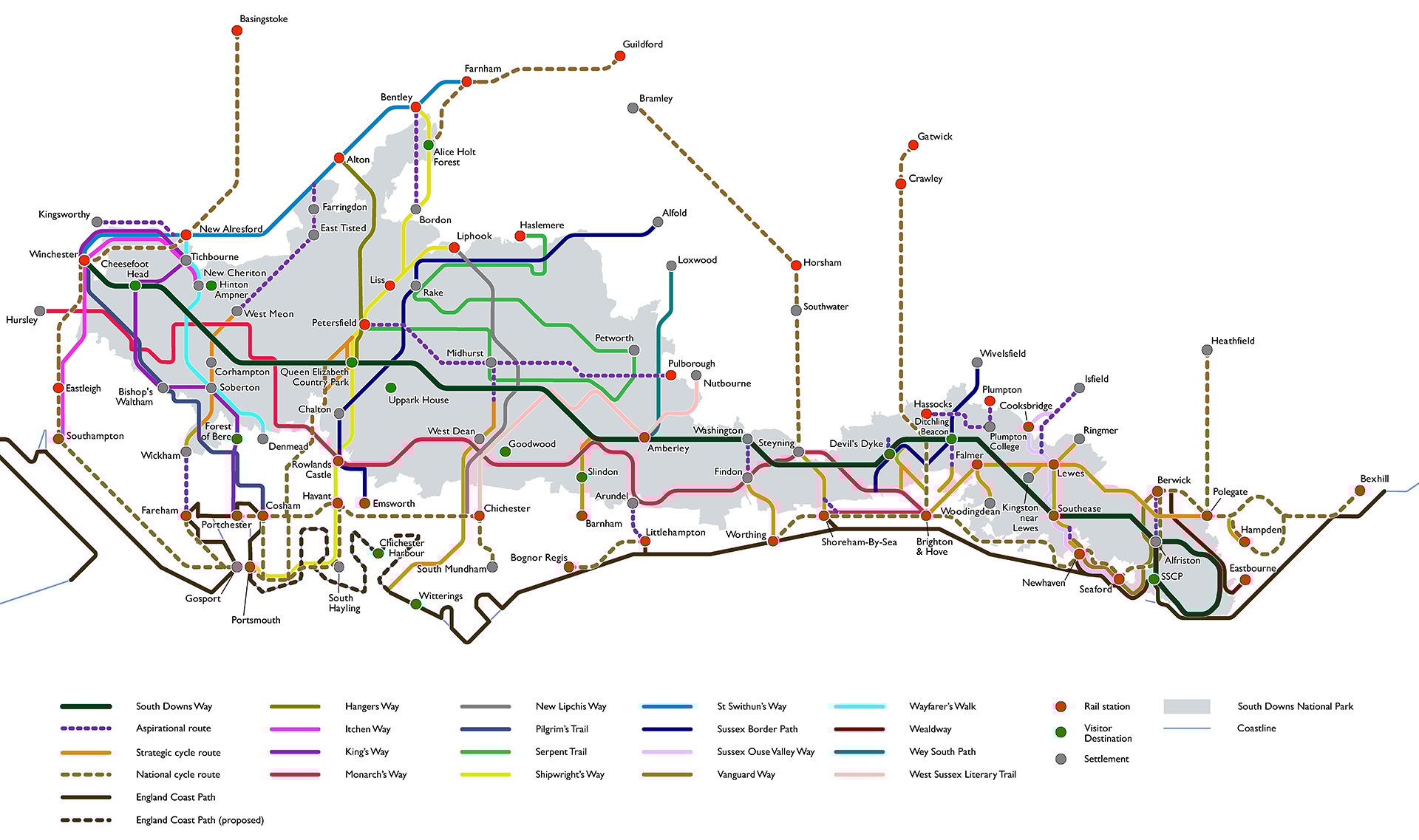
Reducing our reliance on cars to access the National Park is vital to reach net zero and to overcome the barriers faced by those who do not own cars. To do this we must provide accessible, convenient routes into and through the National Park that connect communities into the heart of the landscape and to travel between areas of the National Park. The National Park Authority has worked with partners to develop a South Downs Active Travel Network Plan to prioritise joint action to deliver Active Travel improvements over the life of this Plan. We must also work with transport and other partners to maximise public transport opportunities and to provide information at public transport sites to enable onward travel and enjoyment.
[Insert Cycling and Walking Routes, Trails and Aspirations image]
Read more about Objective 5.1
Enabling people to access the National Park starts well before they leave home. It is ensuring they feel welcome and then providing the information they need to plan their visit – whether that be a quick walk from a neighbouring area or travelling from further afield. Everyone should be able to access information relevant to their needs about how they can connect with the South Downs.
We are committed to bringing the National Park to people where they are – through online and digital content to inform and inspire. We are working with partners to provide onsite information. We are also broadening our partnerships to gather and share new voices and experiences of the National Park.
Our rights of way network – the largest in any National Park and including the entire 100-mile South Downs Way National Trail – is a jewel in the crown of the South Downs. However, it can be greatly improved through relatively small interventions, including removing obstacles such as stiles or steps where possible, improving the surfaces and just maintaining vegetation to increase accessibility and support nature. Improving difficult crossings of roads or developing new off-road routes where missing links exist will greatly enhance the usability of our existing network.
A little over 4 per cent of the National Park land area is Access Land (under the Countryside and Rights of Way Act 2000). Unlike many of England’s upland National Parks which have large continuous areas of Access Land, that in the South Downs is generally small, fragmented areas of downland or heathland. During the lifetime of this Partnership Management Plan, the National Park Authority will work with Natural England to review the current Access Land Open Country mapping, with a view to making this valuable asset more usable.
Reducing our reliance on cars to access the National Park is vital to reach net zero and to overcome the barriers faced by those who do not own cars. To do this we must provide accessible, convenient routes into and through the National Park that connect communities into the heart of the landscape and to travel between areas of the National Park. The National Park Authority has worked with partners to develop a South Downs Active Travel Network Plan to prioritise joint action to deliver Active Travel improvements over the life of this Plan. We must also work with transport and other partners to maximise public transport opportunities and to provide information at public transport sites to enable onward travel and enjoyment.
We will measure “accessible” in relation to our access network as routes which meet the “By all Reasonable Means” designation of “Paths for Some” or above. These routes must have no steps, stiles or barriers restricting access, have no gradient steeper than 1:10 and have a width of over 1m.
Read more about Objective 5.1
Enabling people to access the National Park starts well before they leave home. It is ensuring they feel welcome and then providing the information they need to plan their visit – whether that be a quick walk from a neighbouring area or travelling from further afield. Everyone should be able to access information relevant to their needs about how they can connect with the South Downs.
We are committed to bringing the National Park to people where they are – through online and digital content to inform and inspire. We are working with partners to provide onsite information. We are also broadening our partnerships to gather and share new voices and experiences of the National Park.
Our rights of way network – the largest in any National Park and including the entire 100-mile South Downs Way National Trail – is a jewel in the crown of the South Downs. However, it can be greatly improved through relatively small interventions, including removing obstacles such as stiles or steps where possible, improving the surfaces and just maintaining vegetation to increase accessibility and support nature. Improving difficult crossings of roads or developing new off-road routes where missing links exist will greatly enhance the usability of our existing network.
A little over 4 per cent of the National Park land area is Access Land (under the Countryside and Rights of Way Act 2000). Unlike many of England’s upland National Parks which have large continuous areas of Access Land, that in the South Downs is generally small, fragmented areas of downland or heathland. During the lifetime of this Partnership Management Plan, the National Park Authority will work with Natural England to review the current Access Land Open Country mapping, with a view to making this valuable asset more usable.
Reducing our reliance on cars to access the National Park is vital to reach net zero and to overcome the barriers faced by those who do not own cars. To do this we must provide accessible, convenient routes into and through the National Park that connect communities into the heart of the landscape and to travel between areas of the National Park. The National Park Authority has worked with partners to develop a South Downs Active Travel Network Plan to prioritise joint action to deliver Active Travel improvements over the life of this Plan. We must also work with transport and other partners to maximise public transport opportunities and to provide information at public transport sites to enable onward travel and enjoyment.
Cycling and Walking Routes, Trails and Aspirations
Objective 5.2
Increase the darkness of the National Park’s International Dark Sky Reserve to support nature recovery and improve understanding of and access to dark skies for all.
Dark and starry skies are good for people and for wildlife. They can also play an important role in building a thriving rural economy.
Targets for Objective 5.2
Target 5.2a: Expand the current dark sky core of the International Dark Sky Reserve by 10% by 2031.
Target 5.2b: All lighting authorities in the National Park to adopt 3000K (kelvin) (correlated colour temperature (CCT)) lighting in areas outside and around the National Park, and 2200K inside the National Park, in their lighting policies.
Read more about Objective 5.2
“The night sky is a library of stories that we have been telling ourselves for thousands of years.”
Neil deGrasse Tyson
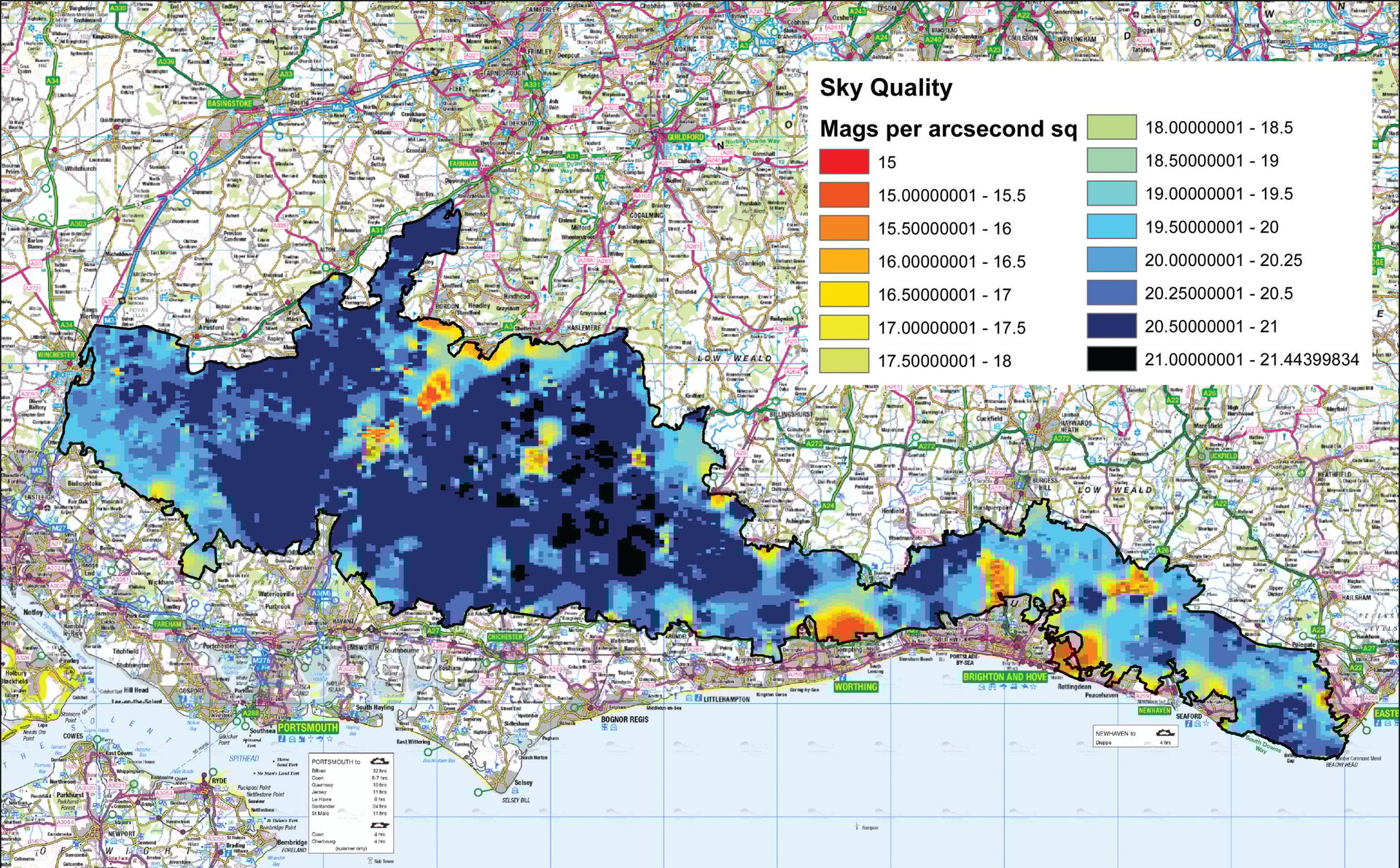
In 2016, the South Downs National Park became the second International Dark Sky Reserve in England, one of only 23 in the whole world today. To be recognised as an International Dark Sky Reserve we had to demonstrate that our starry skies and nocturnal environment were exceptional, and to commit to introduce people to the stars and the wildlife that thrives in the darkness. Situated in the busy south east, we are the closest dark night sky for over 17 million people.
We worked closely with local authorities and other partners to minimise light pollution and achieve our International Dark Sky Reserve status. Now we must work together again to ensure that we not only maintain but improve the quality of our dark skies for this and future generations to come.
Launched in 2020, the Annual Star Count 2023 found that over 51 per cent of people in the UK are living with severe light pollution and only 5 per cent of respondents said they could count over 30 stars in the Orion constellation. Yet in 2020, 98.8 per cent said that 'every child should be able to experience the wonder of a star-filled night sky'. Sadly, for many children, this will be an unknown experience. Light pollution can also have a detrimental impact on our natural rhythm, impacting our health and wellbeing.
Every February the National Park works with partners to run a Dark Skies Festival, a chance for people to come out at night and see the wonder of our skies. What we have found is that there is magic in those stars, for our dark skies are a common and universal language – their wonder speaks to people of all ages, all backgrounds and all heritages. For some it provides tranquillity, an uplifting wellbeing boost, a sense of awe and a chance to connect with times and people past. For others it provides a familiar feel of home and a sense of connection and belonging in a new home.
So, our dark skies play an important role in welcoming new audiences to access the National Park and to build a connection with it.
A light-polluted sky also has a negative impact on wildlife, disrupting the rhythms of key nocturnal species. This can lead to a decline in insects, birds, bats and other species. In the South Downs, 17 out of the UK’s 18 native bat species have been recorded and it is also a haven for owls, moths, churring nightjars and other creatures. If we are to ReNature the South Downs and ensure nature everywhere, for everyone, we cannot ignore the many creatures that depend on darkness.
Read more about Objective 5.2
“The night sky is a library of stories that we have been telling ourselves for thousands of years.”
– Neil deGrasse Tyson
In 2016, the South Downs National Park became the second International Dark Sky Reserve in England, one of only 23 in the whole world today. To be recognised as an International Dark Sky Reserve we had to demonstrate that our starry skies and nocturnal environment were exceptional, and to commit to introduce people to the stars and the wildlife that thrives in the darkness. Situated in the busy south east, we are the closest dark night sky for over 17 million people.
We worked closely with local authorities and other partners to minimise light pollution and achieve our International Dark Sky Reserve status. Now we must work together again to ensure that we not only maintain but improve the quality of our dark skies for this and future generations to come.
Launched in 2020, the Annual Star Count 2023 found that over 51 per cent of people in the UK are living with severe light pollution and only 5 per cent of respondents said they could count over 30 stars in the Orion constellation. Yet in 2020, 98.8 per cent said that 'every child should be able to experience the wonder of a star-filled night sky'. Sadly, for many children, this will be an unknown experience. Light pollution can also have a detrimental impact on our natural rhythm, impacting our health and wellbeing.
Every February the National Park works with partners to run a Dark Skies Festival, a chance for people to come out at night and see the wonder of our skies. What we have found is that there is magic in those stars, for our dark skies are a common and universal language – their wonder speaks to people of all ages, all backgrounds and all heritages. For some it provides tranquillity, an uplifting wellbeing boost, a sense of awe and a chance to connect with times and people past. For others it provides a familiar feel of home and a sense of connection and belonging in a new home.
So, our dark skies play an important role in welcoming new audiences to access the National Park and to build a connection with it.
A light-polluted sky also has a negative impact on wildlife, disrupting the rhythms of key nocturnal species. This can lead to a decline in insects, birds, bats and other species. In the South Downs, 17 out of the UK’s 18 native bat species have been recorded and it is also a haven for owls, moths, churring nightjars and other creatures. If we are to ReNature the South Downs and ensure nature everywhere, for everyone, we cannot ignore the many creatures that depend on darkness.
Challenges facing water in the South Downs National Park
Dark Skies Map of the South Downs National Park
The night sky is a library of stories that we have been telling ourselves for thousands of years.
Neil deGrasse Tyson

Read more about Objective 5.2
In 2016, the South Downs National Park became the second International Dark Sky Reserve in England, one of only 25 in the whole world today. To be recognised as an International Dark Sky Reserve we had to demonstrate that our starry skies and nocturnal environment were exceptional, and to commit to introduce people to the stars and the wildlife that thrives in the darkness. Situated in the busy south east, we are the closest dark night sky for over 17 million people.
Dark and starry skies are good for people and for wildlife. They can also play an important role in building a thriving rural economy. Dark skies are best viewed over the winter months when tourism businesses are typically quiet. We have created a “Dark Skies Welcome” for businesses and there is real potential to grow dark skies tourism.
We worked closely with local authorities and other partners to minimise light pollution and achieve our International Dark Sky Reserve status. Now we must work together again to ensure that we not only maintain but improve the quality of our dark skies for this and future generations to come.
Launched in 2020, the Annual Star Count 2023 found that over 51 per cent of people in the UK are living with severe light pollution and only 5 per cent of respondents said they could count over 30 stars in the Orion constellation. Yet in 2020, 98.8 per cent said that 'every child should be able to experience the wonder of a star-filled night sky'. Sadly, for many children, this will be an unknown experience. Light pollution can also have a detrimental impact on our natural rhythm, impacting our health and wellbeing.
Every February the National Park works with partners to run a Dark Skies Festival, a chance for people to come out at night and see the wonder of our skies. What we have found is that there is magic in those stars, for our dark skies are a common and universal language – their wonder speaks to people of all ages, all backgrounds and all heritages. For some it provides tranquillity, an uplifting wellbeing boost, a sense of awe and a chance to connect with times and people past. For others it provides a familiar feel of home and a sense of connection and belonging in a new home.
So, our dark skies play an important role in welcoming new audiences to access the National Park and to build a connection with it.
A light-polluted sky also has a negative impact on wildlife, disrupting the rhythms of key nocturnal species. This can lead to a decline in insects, birds, bats and other species. In the South Downs, 17 out of the UK’s 18 native bat species have been recorded and it is also a haven for owls, moths, churring nightjars and other creatures. If we are to ReNature the South Downs and ensure nature everywhere, for everyone, we cannot ignore the many creatures that depend on darkness.
Dark Skies Map of the South Downs National Park